Intent-Driven Network Automation Agent

Overview
The Intent-Driven Network Automation Agent is an AI-powered system designed to translate natural language instructions into structured network configurations. It supports automated provisioning and management of BGP and VLAN configurations using Ansible.
The agent enables network engineers to define desired outcomes in plain language, which are then parsed, validated, and executed across network devices.
Key Capabilities
- Natural language to network intent translation
- Automated BGP peering configuration
- VLAN creation, deletion, and inspection
- Intent validation prior to execution
- Parallel configuration across multiple devices
- Post-deployment verification of network state
- YAML-based intent generation
Agent Definition
Name: BgpIntentAgent
Description: An AI-based network automation agent that interprets user intent, generates structured configuration data, and applies changes to network devices using Ansible automation.
Tools and Their Uses
| Tool Name | Description / Use |
|---|---|
list_supported_intents |
Returns all supported intent types available in the agent |
get_intent_template |
Retrieves the predefined structure for a given intent type |
parse_bgp_intent |
Extracts ASN, router IPs, and credentials from natural language input |
validate_bgp_intent |
Validates the correctness and completeness of BGP intent data |
generate_intent_yaml |
Converts structured intent into YAML format |
check_ansible_installed |
Verifies whether Ansible is installed on the system |
run_ansible_bgp |
Executes BGP configuration across routers using Ansible |
check_existing_bgp_connection |
Checks if BGP peering is already configured and its state |
check_bgp_status |
Retrieves BGP summary from routers |
remove_bgp_configuration |
Removes BGP configuration from routers |
parse_vlan_intent |
Extracts VLAN ID, name, switch IPs, and credentials from input |
list_vlans |
Lists VLANs configured on switches |
Tool Responsibilities
BGP Tools
Intent Parsing Extracts ASN, router IP addresses, and credentials from user input. Automatically builds neighbor relationships between routers.
Validation Ensures required fields such as ASN and router list are present and valid.
Configuration Execution Applies BGP configuration using Ansible. Assigns unique AS numbers per router and establishes neighbor relationships dynamically.
Verification Checks whether BGP sessions are established and provides summary outputs from devices.
Removal Deletes BGP configuration from target routers.
VLAN Tools
Intent Parsing Extracts VLAN ID, VLAN name, switch IP addresses, and credentials.
Validation Ensures VLAN ID falls within the valid range (1–4094).
Configuration Execution Creates VLANs on switches using appropriate CLI commands via Ansible.
Monitoring Retrieves VLAN information from switches.
Removal Deletes VLANs from specified switches.
Operating Rules and Constraints
- Default ASN is 1001 if not specified
- Minimum of two routers required for BGP configuration
- VLAN ID must be between 1 and 4094
- Intent must be validated before execution
- Only Ansible ad-hoc commands are used
- SSH host key checking is disabled
- Parallel execution is used for scalability
Authenticate with NCP
ncp login
Install NCP SDK Package
pip install ncp
Create NCP Package
ncp build
This command generates a deployable .ncp package.
Deploy Agent to NCP Playground
ncp deploy
Using the NCP Interface
- Open the NCP Playground
- Select the BgpIntentAgent
- Enter natural language commands
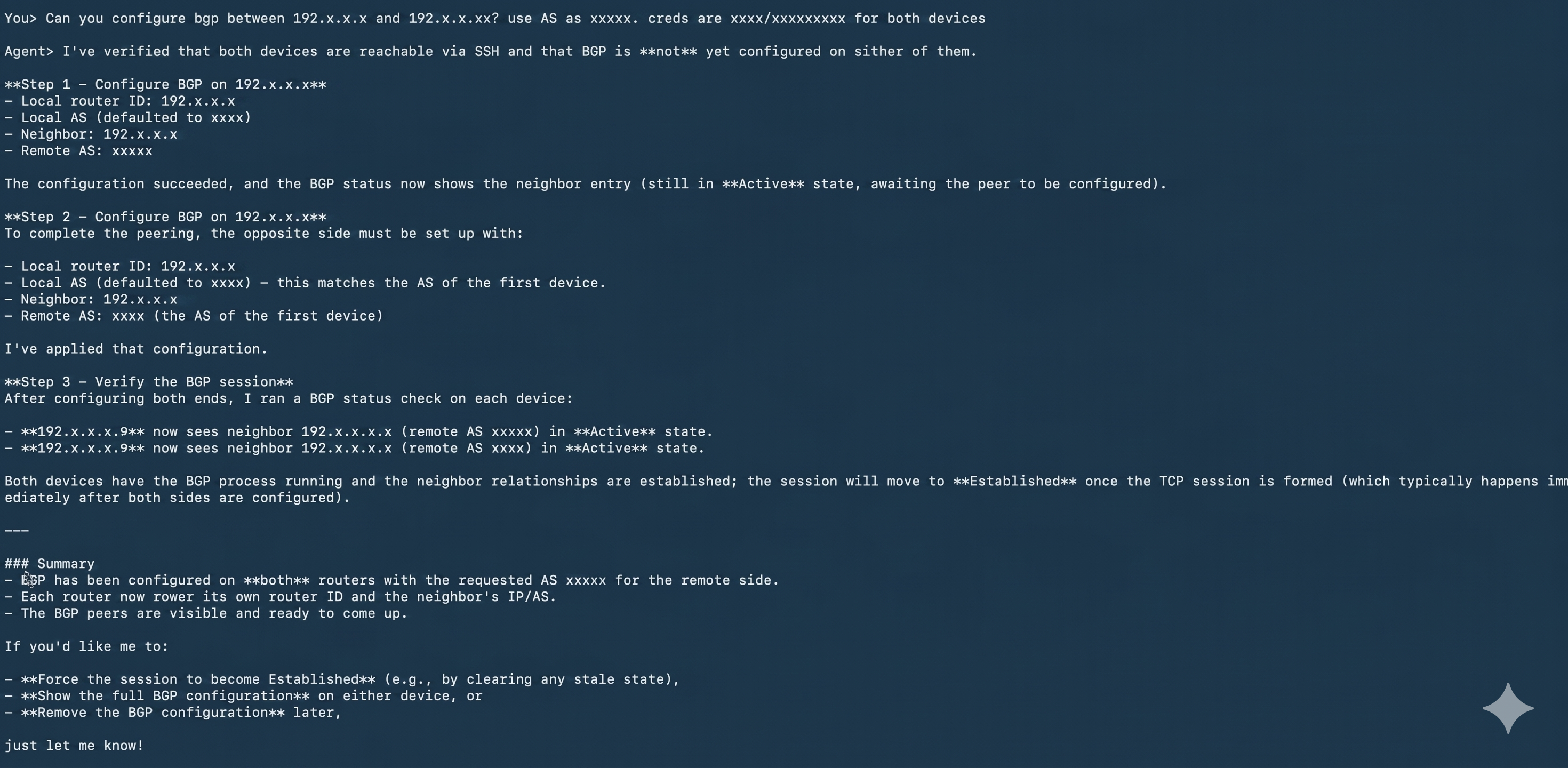
Example BGP Request
Configure BGP between x.x.x.x and x.x.x.x with ASN 65000 creds admin/admin
Example VLAN Request
Create VLAN 100 name SALES on x.x.x.x creds admin/admin
Screenshots
BGP configuration execution output
Example Workflow
Input:
Setup BGP between x.x.x.x and x.x.x.x ASN 65000
Execution Flow:
User Input
    ↓
Parse Intent
    ↓
Validate Data
    ↓
Check Existing BGP
    ↓
Apply Configuration (Ansible)
    ↓
Verify BGP Status
    ↓
Success/Error Output